
Introduction
Ukraine’s media sector stands at a turning point. It is shaped by war, a fast digital shift, and the constant demand for credibility. At the same time, financial gaps, outdated platforms, and the challenge of building trust create a reality where speed and reliability are no longer optional. They are essential for survival.

Survival math for media: funding, trust, technology
Independent Ukrainian outlets face a funding crisis. According to the Pulitzer Center, much of their work still depends on foreign aid. Recent freezes in USAID programs have worsened the problem, leaving dozens of newsrooms with fewer resources to continue operating.
For many, the financial issue is tied directly to technical stagnation. Websites are outdated, often slow, and difficult to edit. Editorial teams spend unnecessary hours fixing glitches or trying to push content through clunky admin panels. Search visibility is another obstacle: getting noticed on Google requires skills and strategy that not every newsroom can afford to build. The user shift to mobile has added one more layer. What used to be a desktop-first experience now requires fast, user-friendly mobile platforms, and too many outlets are lagging behind.
On the front line: tools that work at the speed of news
In wartime, Ukrainian journalists cannot afford delays. Outlets that report from the front line need to publish updates within minutes. If their tools slow them down, they lose the race for relevance and risk credibility.
Admin systems should be intuitive enough for any journalist, even someone with only print experience, to log in and publish a story without training. Uploading a quote, embedding a source, or linking to official profiles should take seconds, not hours.
Credibility is also a technical issue. Readers expect proof. That means design features that highlight verified quotes, links to original sources, logos of institutions, and profiles of people cited. These details are not extras. They are part of the infrastructure that sustains trust.
Analytics as a growth engine
The more ambitious outlets in Ukraine use analytics as a compass. They do not wait for data to confirm choices; they use it to guide decisions. Metrics help them choose topics, refine SEO, and expand reach.
From our experience, independent media that grow consistently make analytics part of their strategy from the start. They build plans around measurable outcomes, not guesses. That commitment often separates small local outlets that struggle from those that grow into widely recognized voices.
What media outlets really need
Ralabs has worked with the media industry for years, supporting independent outlets and established newsrooms. We have helped many update their platforms, modernize design, and overcome the technical barriers that slowed their work.
Most of the requests we receive sound familiar because the challenges are shared across the sector. Common needs include:
- A new website from scratch, especially when the outlet began on Instagram or Facebook.
- Redesign of an existing platform, usually one burdened with outdated layouts and heavy archives.
- Migration to WordPress with a modern theme.
- UX improvements that let non-technical editors publish easily.
- Mobile-friendly versions that load quickly and retain users.
Underneath these requests lies one unifying need: a platform that is simple to manage, visible in search, optimized for mobile, and affordable to maintain.
Case studies that prove the point
Our work with Ukrainian outlets shows how technology can unlock growth.
MediaPort had a long history and a huge archive, but its website slowed the newsroom down. We migrated the entire archive, redesigned the platform, and made it both SEO-friendly and reader-friendly.
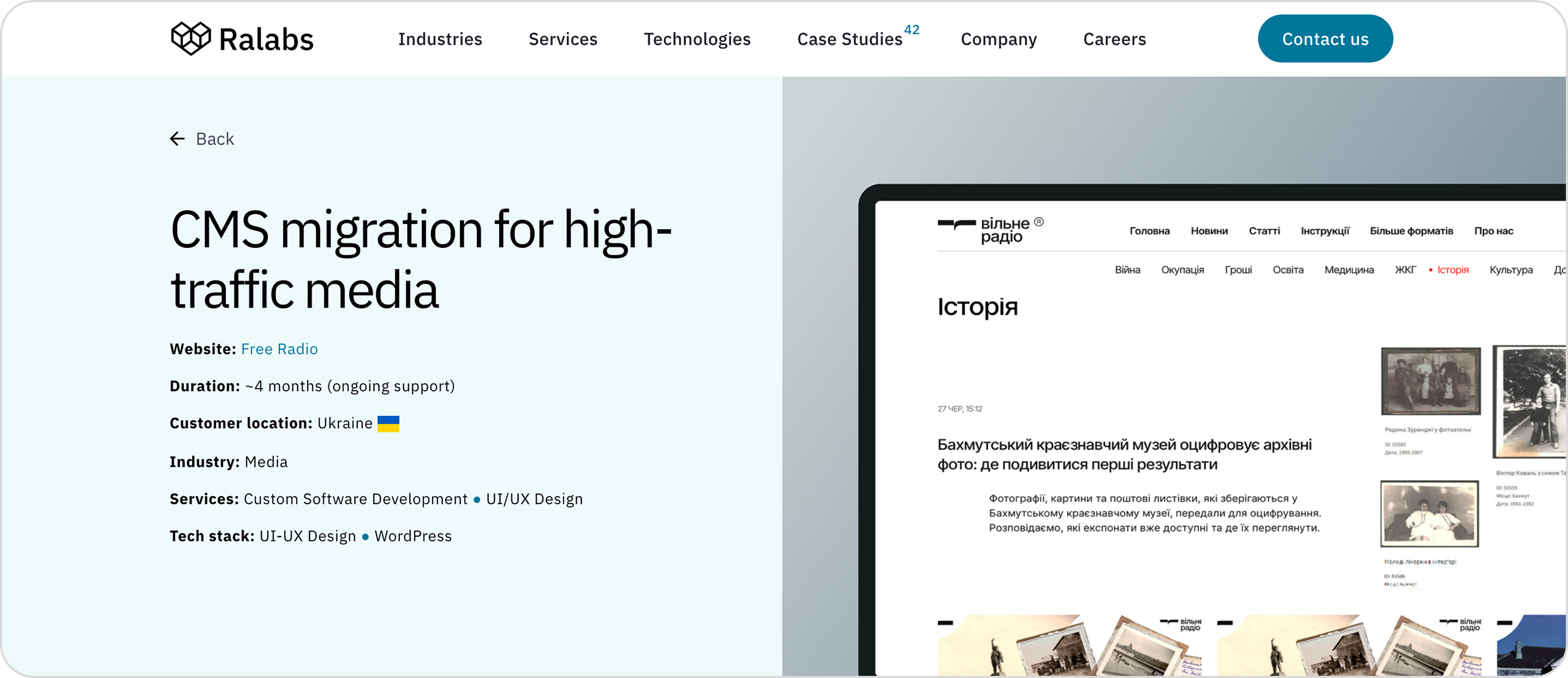
Free Radio had a similar challenge. Years of publishing had created a fragmented archive with inconsistent formats. We migrated the content, adapted old material to a modern theme, and introduced SEO improvements. The new design gave the outlet a fresh, modern look while preserving its history.
Frontliner relied heavily on photography and video. Their challenge was balancing high-quality visuals with speed. We built a platform where images and video can be published without loss of quality and without slowing down the site. For a newsroom that tells stories through multimedia, this balance was essential.
What media teams value most
Feedback from media partners highlights a few constants. They value speed of execution and clarity in approach. They point out that our solutions align with both user expectations and Google’s standards. They also appreciate that we explain technical options in plain language.
For many, what stands out is not just the technical work but the partnership. They see us as an extension of their team, helping them reach measurable goals.
Why we fit the media industry
Our advantage comes from experience. We have built platforms for newsrooms with limited budgets, massive archives, and high-pressure publishing needs. Just as important, we believe in the role of independent journalism and see our work as contributing to it.
For us, these projects are never just another set of websites. They are support for those who document history, hold institutions accountable, and inform citizens. The technical solutions may look like code and design, but the real impact is measured in trust and readership.
Ukraine’s press freedom in context
Despite war and financial pressure, Ukraine’s press freedom has shown resilience. The country ranked 61st out of 180 in the 2025 World Press Freedom Index, its highest position since independence. Yet the risks remain immense. Journalists continue to expose war crimes, disinformation, and corruption while facing personal danger on the ground (ECPMF)
According to Reporters Without Borders, investigative outlets are producing groundbreaking work but remain in urgent need of technical and financial support. Independent journalism survives, but it does so under constant strain.
Reporters Without Borders
For outlets considering growth, several recommendations stand out:
- Look at larger peers for inspiration, but adapt ideas to your own goals instead of copying blindly.
- Prioritize mobile experience, since readers now arrive primarily through phones.
- Keep admin tools simple, so editorial teams can focus on journalism rather than technical barriers.
- Let analytics guide decisions rather than relying on instinct alone.
- Design credibility into the product. Highlight quotes, sources, and references to strengthen trust.
- Partner with teams that share your mission and values, not just those that offer technical skills.
From pressure to progress
The Ukrainian media sector faces pressure from every direction. Funding is fragile, technology is outdated in too many cases, and the editorial mission is carried out under wartime conditions. Yet outlets continue to publish, to innovate, and to grow.
Behind every article or investigation lies a chain of technical decisions. When platforms are modern, intuitive, and credible, they empower journalists to focus on what matters most: telling the truth.
At Ralabs, we do not just design websites. We provide custom media software development services that help newsrooms survive, adapt, and thrive in a landscape that changes every hour. Technology will not save journalism on its own. But the right technology can make journalism possible.