Introduction
Vibe coding is the newest shift in how developers build software in 2025. Instead of typing every line, you describe what you want and the AI writes the code. It’s AI-assisted coding based more on intention than instruction. Developers, product folks, and C-suite execs are asking: can we trust vibes? What happens when code is less about writing lines and more about speaking ideas? We, as a tech company deeply watching the field, have gathered detailed insights so you make smart decisions.
What is vibe coding?
Coined by Andrej Karpathy early in 2025, vibe coding refers to describing what you want in natural language (or voice or prompts) and having AI models generate, refine, and sometimes even run code based on those descriptions, rather than writing every line yourself.
It’s different from traditional AI pair programming, where you inspect and correct each suggestion. With vibe coding you lean more heavily on iteration, experiment, and the output. If the first version doesn’t match, you adjust by prompt or test, rather than coding fundamental architecture first.
Why it matters now
- Speed of prototyping: Vibe coding dramatically shortens the time from idea to demo. Forbes notes that some startups now use it to build lightweight features in hours instead of days.
- Lower barrier of entry: Less experienced developers and designers, even people without deep coding training, can participate by expressing requirements in natural language. This opens software development to a wider audience.
- Iteration and experimentation: Because you can try different prompts, see results, refine, vibe coding encourages more iteration. That can lead to creative and unexpected solutions. Wired shows how a Notion engineer experimented with vibe coding and discovered new approaches to UI features.
- Resource leverage: Leaner teams can do more. Business Insider reports that YC founders increasingly rely on AI-generated code in their early-stage products.
What are the main benefits of using vibe coding
Rapid feedback loops
Developers and product teams can see working output in minutes. This is especially useful for proofs of concept or internal demos.
Flexibility in early stage design
Vibe coding allows fast experimentation with UI, UX, and feature flows without heavy upfront architecture.
Cost effectiveness for prototypes
By cutting down boilerplate and repetitive tasks, vibe coding reduces the hours spent on initial builds. Resources can then be shifted toward refining business logic and product direction.
Empowering non-specialists
Product managers, designers, and entrepreneurs can describe what they want in natural language, reducing friction between roles. This makes cross-functional collaboration smoother.
Stimulating innovation
Because teams can adjust prompts and iterate quickly, vibe coding often surfaces creative approaches that would not appear in a traditional “engineer-first” workflow.
What are the main limitations of vibe coding
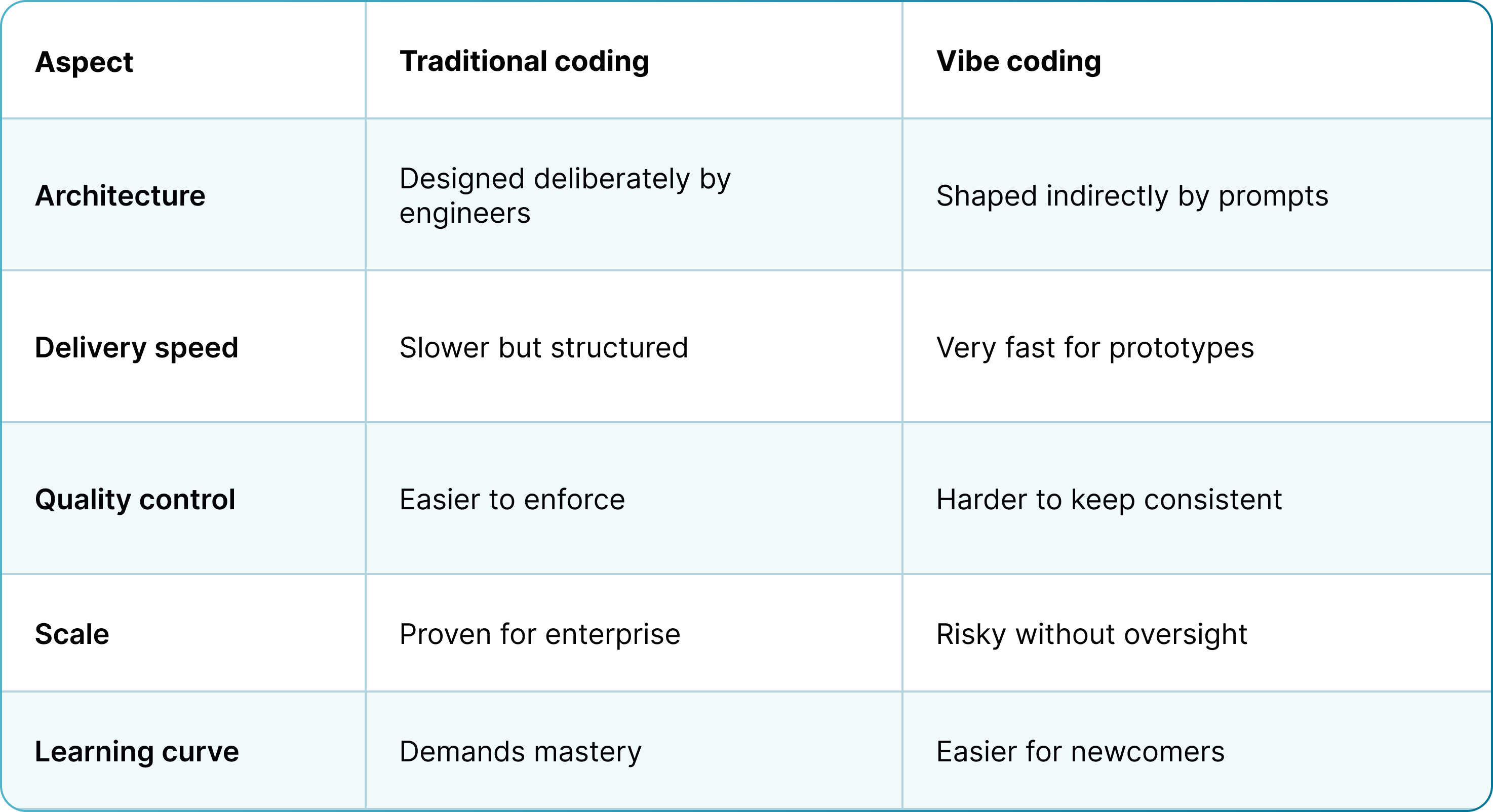
Code quality and consistency
AI-generated code may lack uniform style and architecture. Without strict review, projects risk becoming fragmented.
Technical debt accumulation
Early speed often comes at the cost of future maintainability. Teams may find themselves rewriting large parts of code later.
Debugging and testing challenges
Understanding how AI-generated logic works can be difficult. Developers may struggle to locate bugs or validate edge cases.
Security risks
Poorly reviewed AI-generated code may introduce vulnerabilities, such as outdated libraries or unsafe authentication flows. Forbes highlights the emerging role of “vibe coding cleanup specialists” tasked with fixing these issues.
Scalability and maintainability
For large, complex systems, vibe coding lacks the stability of traditional engineering processes. Wired notes that while it shines for experiments, robust enterprise builds still demand full developer oversight.
Responsibility gaps
If teams rely heavily on AI output without understanding it, accountability for bugs, compliance, and long-term performance becomes blurred.
Industry examples and use cases
Startup prototyping: Wired describes how Notion let an outsider “vibe code” a new feature, showing how quickly ideas can be turned into working UI elements.
Lean early-stage teams: Business Insider reports that Y Combinator founders increasingly rely on vibe coding to build MVPs, cut costs, and test market fit before scaling up engineering teams.
Cross-functional collaboration: Vibe coding empowers product managers and designers to translate their intent directly into software prototypes without waiting on full engineering cycles.
Ralabs case: One of our clients came with code produced entirely through vibe coding. While the prototype worked, it lacked structure, security controls, and maintainability. Our engineers stepped in to review, refactor, and align it with best practices. Once reworked, the product scaled smoothly. This experience proved that vibe coding can accelerate ideation, but real-world delivery still requires strong engineering oversight.
Risks and security: what to watch
When applying vibe coding in professional environments, these points need close attention:
Audit generated code
AI tools may introduce outdated or vulnerable dependencies. Teams should review every addition before merging.
Maintain traceability
Document prompts and iterations to understand how code was produced. This helps in debugging and accountability.
Enforce reviews and tests
Never skip peer reviews or automated tests, even if the AI-generated code “looks right.” Hidden flaws may only surface under load.
Limit critical usage
Reserve vibe coding for prototypes, front-end experiments, or internal tools. For regulated systems or production-critical code, traditional coding practices remain safer.
Choose platforms carefully
Security lapses have already surfaced in some vibe coding tools. TechRadar reports incidents of exposed APIs and authentication bypasses. Always validate vendor security practices.
Conclusion
Vibe coding brings enough promise to justify serious experimentation. For prototypes, internal tools, and situations where speed and creativity matter most, it can compress feedback cycles, broaden participation, and unlock new ideas.
But for complex, scalable, and secure systems, the traditional engineering approach still wins. Enterprise projects demand reliability, maintainability, and compliance that vibe coding alone cannot guarantee. Forbes has already pointed out the rise of “cleanup specialists,” showing how fast-generated code often needs professional rework.
Vibe coding is worth trying, especially for experiments and MVPs. But once a product grows, it still needs careful engineering. At Ralabs, we’ve seen both sides: vibe-coded prototypes that inspire, and the cleanup work required to make them stable. The best results come when you mix the speed of AI with the discipline of seasoned developers.
If you’ve explored what vibe coding can do, Ralabs can step in to refine, secure, and scale your product with proven engineering practices.