Introduction
For years, conversations about artificial intelligence have been dominated by names from the United States and China. Then a French startup called Mistral AI appeared, and the balance started to shift. Founded in 2023 by Arthur Mensch, Guillaume Lample, and Timothée Lacroix, the company has become Europe’s loudest answer to OpenAI’s dominance. Within two years, it turned from a research experiment into one of the most valuable AI companies on the continent.
The rise of a European challenger
In September 2025, Reuters reported that Dutch chipmaker ASML became Mistral’s largest shareholder after leading a €1.3 billion funding round. That deal lifted Mistral’s valuation to about €11 billion and turned it into Europe’s most valuable AI company. But this was more than a financial milestone. It was a sign of Europe’s growing confidence that it can compete on AI infrastructure, not just regulation.
TechCrunch called Mistral “Europe’s OpenAI moment,” noting how quickly it built both technical credibility and public visibility. Unlike the fully closed model of ChatGPT, Mistral built a portfolio that mixes open-weight models with paid APIs. The company’s open releases, such as Mistral 7B and Mixtral 8×7B, give developers access to powerful systems under permissive licenses. For enterprise use, it offers Mistral Large 2, a 123-billion-parameter model designed for long-context reasoning, and Devstral, tuned for software engineering tasks.
Where it stands against ChatGPT
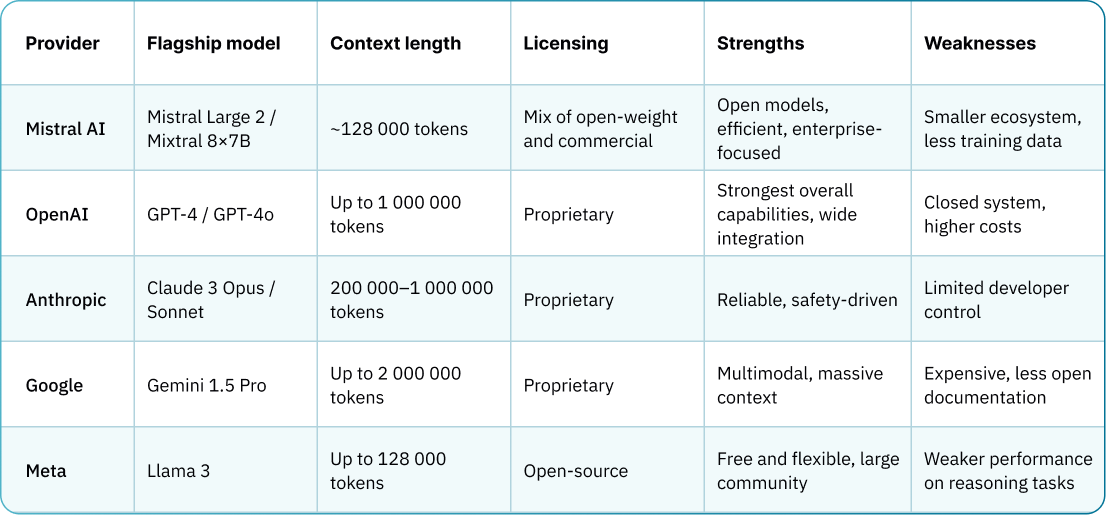
The comparison with ChatGPT is inevitable. OpenAI’s flagship GPT-4 runs with a one-million-token context window and a global user base in the hundreds of millions. Mistral’s Large 2 model handles roughly 128 000 tokens. While smaller in scale, it is lighter to deploy and more efficient for European businesses that want to host models privately. That trade-off between size and sovereignty is the heart of Mistral’s strategy.
Instead of building a single consumer product, Mistral focuses on infrastructure. Its Agents API allows developers to create persistent, tool-using agents that remember context and execute code. This is a clear step toward enterprise automation rather than mass-market chatbots. It is also the kind of product engineering teams at Ralabs pay close attention to, since it reflects how AI is quietly moving from conversation to orchestration.
It was an AI-powered support layer that:
Ingested tribal knowledge from live conversations
Mistral also released Le Chat, its French-language chatbot that reached one million downloads within two weeks of launch. Priced at $14.99 per month for the Pro plan, it serves as a public showcase while the company concentrates on enterprise deals.
Open models, sovereignty, and strategy
Europe’s AI race is as political as it is technical. Wired described Mistral as a product of President Macron’s “startup nation” vision, built on state funding and a belief that Europe should own its core technologies. By maintaining open models and releasing code under the Apache 2.0 license, Mistral positions itself as a bridge between open research and enterprise pragmatism.
Still, not everyone sees it as Europe’s OpenAI. Le Monde warned against portraying Mistral as being on par with ChatGPT, arguing that the gap in scale, data, and ecosystem remains wide. Yet, the paper also acknowledged that ambition matters. For the first time, Europe has a contender that is not just copying U.S. playbooks but inventing its own.
Regulation and resistance
Mistral’s rise coincides with the rollout of the EU AI Act, the world’s most comprehensive AI law. Earlier this year, Mistral joined other European startups in signing a letter urging Brussels to delay enforcement for two years, claiming companies needed time to adapt. The European Commission dismissed the proposal, insisting the timelines remain binding. That exchange, covered by Reuters, underlined how difficult it is to balance innovation and compliance in Europe’s regulatory environment.
For Mistral’s clients, this context is crucial. Adopting European AI models means embracing stricter data protection and auditability standards. Mistral’s partial openness, documented transparency, and commitment to self-hosted options make it a practical choice for teams operating under GDPR and sector-specific frameworks.
A shifting competitive map
Globally, Mistral stands among giants. OpenAI continues to lead on raw capability and integration. Anthropic’s Claude 3 models push safety and reliability. Google’s Gemini 1.5 Pro stretches context windows up to two million tokens, while Meta’s Llama 3 family dominates open-source adoption.
Mistral blends elements of each. Like Meta, it believes in open access; like OpenAI, it builds polished commercial tools. Its Mixtral 8×7B model uses a sparse mixture of experts that activates only a few sub-networks per query, cutting energy use while maintaining strong performance. This architecture, highlighted in TechCrunch, is part of why Mistral can run smaller, faster, and greener systems – an advantage in markets where sustainability reporting is no longer optional.
Pricing plays its part. Le Chat Pro is accessible for individuals, while enterprise API costs scale by usage. For companies experimenting with in-house fine-tuning, this flexibility often results in lower total cost than managed GPT-4 APIs. The company regularly publishes updates and research on its news page, keeping both developers and investors engaged.
Why it matters
Mistral’s rise is more than a European success story. It redefines what “open” can mean in commercial AI. It proves that a small, research-driven team can stand toe-to-toe with trillion-dollar corporations and still keep transparency at its core. It also shows that competition need not rely on scale alone but can be built around principles: accessibility, sovereignty, and efficiency.
Probably, it is too early to crown Mistral as OpenAI’s equal. But it has already changed the conversation. The battle is no longer about one company versus another. It is about whether the future of AI will be dominated by closed, centralised systems or shaped by a network of interoperable, locally governed ones.
Europe now has a real contender in that debate. And whether Mistral wins or not, it has already forced the industry to look in its direction.
At Ralabs, we help companies turn new AI technologies into practical products. If your team is exploring AI development or model integration, let’s talk about the right approach for your business.