Introduction
At I/O 2025, instead of simply rolling out the batch of product updates, Google pulled the rug out from under traditional search.
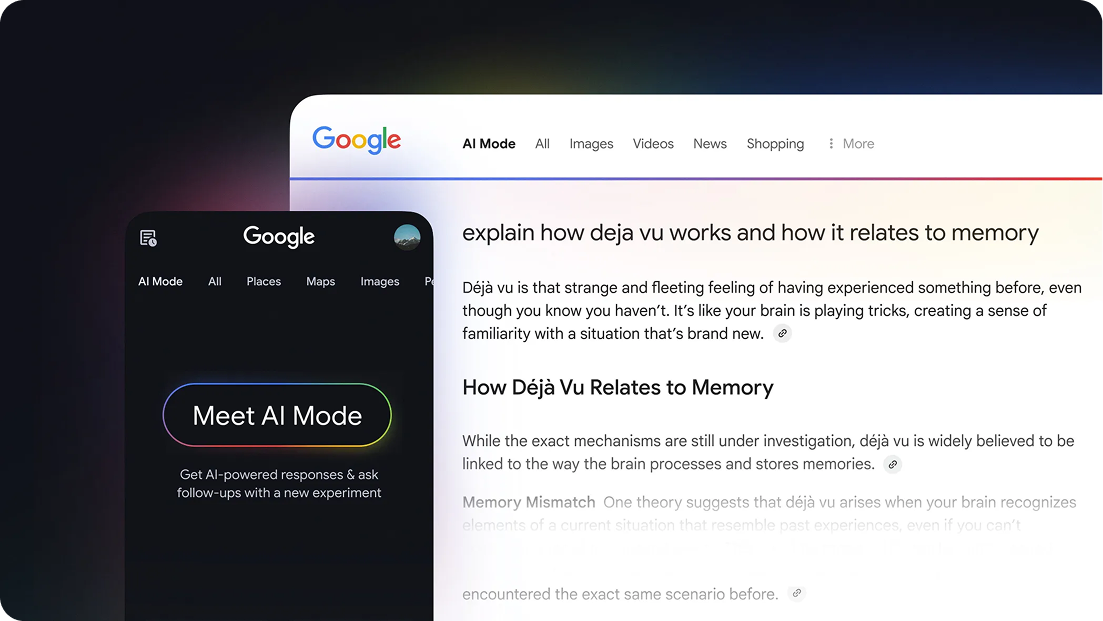
The headline announcement was “AI Mode,” a fully reengineered search experience powered by Gemini 2.5 Pro. Users now get AI-generated answers, image-based search capabilities, and the ability to follow up with questions in a more natural conversation.
For businesses, publishers, and developers, it raises pressing questions about discoverability, traffic, and visibility in a system that no longer leads with blue links.
Core features of Google’s AI mode
AI Overviews now anchor the top of many result pages. These summaries are stitched together from multiple sources and aim to provide direct answers up front — links are still there, but they’ve been demoted to supporting detail.
Conversational Follow-Ups allow users to ask layered questions without repeating themselves. Queries can evolve organically, with context carrying across the exchange.
Multimodal Input opens the door to visual and voice interactions. Snap a photo, speak a query, or type — Search adapts to your preferred mode.
Gemini Everywhere is more than a tagline. The AI backbone now spans Google’s ecosystem, from mobile and desktop search to apps and devices, driving consistent personalization and smarter responses across touchpoints.
As Google puts it, Search is evolving from a tool into a companion — built not just to answer, but to understand.
Why AI mode upends the web’s economics
The launch of AI Mode challenges the entire incentive system that shaped the modern internet.
Sundar Pichai, Google’s CEO, opened I/O 2025 with numbers that signal a full-scale shift: 480 trillion tokens processed per month (up 50x from last year), 400 million Gemini users, and over 1.5 billion people engaging with AI Overviews monthly. This isn’t hype — it’s how your customers are already searching.
AI Mode, now live for all U.S. users, fans out queries in the background, compiles answers across sources, and delivers a complete response — before users click anything. That realignment has immediate consequences for how visibility, attribution, and conversion work online.
Key shifts every marketer and publisher needs to understand:
- Your page rank no longer guarantees exposure – If AI summaries cover the user’s intent, they may never see your site — even if you rank first.
- Search is becoming agentic – Google previewed a future where AI doesn’t just recommend, but acts. Booking, buying, and decision-making could be handled autonomously.
- Visual input is the new query – With Google Lens use up 65% year-over-year and Search Live enabling “video call” queries, visual discoverability is now core to search strategy.
- Content must feed the model, not just the algorithm – Thin content is out. Rich, structured, context-aware content stands a better chance of being cited by AI.
- AI tools are raising the bar – With Imagen 4 and Veo 3 streamlining image and video creation, your content doesn’t just need to exist — it needs to compete on quality.
Behind the scenes, AI Mode reflects a deeper shift in incentives. The internet used to reward click-throughs. Now, it may reward mere presence in the model’s output — often without attribution, traffic, or control over how your content is used.
Yes, Google is literally redefining what it means to be found.
The new rules of search optimization
The traditional SEO playbook — keywords, backlinks, ranking — wasn’t built for AI-first search. With AI Mode, Google doesn’t just crawl and index pages. It interprets intent, dissects context, and builds composite answers. If your content isn’t designed to train the model, you’re not in the game.
This shift has sparked the rise of a new discipline: Generative Engine Optimization (GEO). It’s no longer about where your link appears. It’s about whether your content is good enough to be surfaced, summarized, or even mimicked by AI.
What now matters:
Structured, AI-Readable Content – Google is scanning your content not for snippets, but for context-rich, clearly organized information it can pull from. Schema markup and semantic clarity aren’t optional.
Domain Authority Still Wins – High-trust sites have a better shot at being cited in AI Overviews. Expect consolidation: the top 1% of sites may dominate exposure while smaller players get filtered out.
Mentions Over Clicks – Visibility is becoming detached from traffic. Your brand might get cited in an answer without earning a visit — which shifts the goal from CTR to influence.
Middle and Bottom Funnel Matter More – Google’s AI excels at top-of-funnel summaries. To stand out, you need deep product comparisons, how-tos, case studies — the stuff AI can’t easily fabricate.
Topic Clusters Are the New Pillars – Because AI Mode fans out a single query into dozens of background searches, your content needs to map to those sub-intents. Pages should cover related concepts, not just keywords.
If you’re still writing for the algorithm, you’re already behind. AI Mode prioritizes content that reflects expertise, context, and experience — the things machine-generated summaries still struggle to replicate.
The industry reacts: control vs. convenience
The debut of AI Mode has triggered sharp divides across the web ecosystem. For users, the experience is fast, seamless, and intuitive. For publishers, marketers, and open web advocates, it’s something else entirely: a centralization of control under the guise of convenience.
Here’s where the flashpoints are emerging:
Publishers are sounding the alarm – When Google delivers full answers on the results page, fewer users click through. That’s already been the case with AI Overviews — now scaled to over 1.5 billion users per month. For many content creators, AI Mode looks like the next stage of traffic cannibalization.
Attribution is muddled – AI summaries cite sources inconsistently. Sometimes it’s a cluster of links at the bottom. Sometimes there’s no link at all. For an internet built on traceable discovery, that’s a fundamental break in the chain.
Smaller sites get squeezed – Without clear rules on how AI chooses what to include, niche content and newer voices risk being excluded from summaries entirely — regardless of quality.
SEOs are split – Some see opportunity in optimizing for AI-generated responses. Others view it as a black box that undermines years of search strategy. GEO is gaining traction, but the roadmap remains unclear.
Users seem impressed — for now – The core appeal is real: faster answers, less clicking, fewer ads. But early concerns about factual drift, source bias, and hallucinated answers haven’t gone away — and as usage grows, scrutiny will follow.
The tension is obvious: Google’s move makes Search more useful in the short term, but potentially less open in the long run. Whether this reshapes the web for better or worse depends on how transparent, and accountable, Google is willing to be.
The future of finding
Google just laid out the blueprint for what comes next: search that acts.
In I/O demos, Google previewed “agentic” experiences where AI doesn’t just recommend a restaurant — it books the table, orders the meal, and splits the bill. This vision pushes search beyond retrieval into autonomous decision-making. And it’s not theoretical.
What’s coming into focus:
Agents that execute – Google is testing Agent Mode, an AI that can guide users from intent to transaction. Think: planning a trip, comparing skincare products, or researching EVs — all handled in one interactive flow, no tabs required.
Proactive Search – With Gemini integrated across Chrome, Android, and Gmail, Google has the context to anticipate your needs before you ask. Expect search prompts that emerge from your calendar, inbox, or location.
Persistent AI across devices – Search is being embedded into everything — your phone, car, wearables, even Google’s forthcoming Android-powered XR glasses. The AI assistant of the future won’t wait for input. It’ll be ambient.
This evolution raises new questions. If Google becomes both gateway and gatekeeper — answering, acting, and buying on users’ behalf — what role remains for brands? For websites? For competition?
The answer isn’t clear. But the battleground has shifted. Search is no longer about ranking higher — it’s about being the source that agents trust to act on.