




Agentic AI
Development Services
Most agentic AI projects stall between pilot and production.
Our agentic AI services cover the full path from architecture to live deployment — connected to your real tools and data, without rewriting your core systems.
Key numbers
Our case studies
Team size: 9 developers
Team size: 2 developers
Team size: 4 developers
Team size: 6 developers
Our clients say
Jeff Wallace
Co-Founder at Silicon Valley in Your Pocket
“We are thrilled to have such a knowledgeable, skilled and collaborative team in Ralabs as we build our business into the future. They helped us to create an excellent solution, one that met our early pilot needs but that was also scalable to meet our long-term requirements.”
Rhodes Kriske
Marketing Director at WayThru Innovations

“Ralabs consistently delivers high-quality outputs, and they’re able to mitigate any risks to the web app. The team is responsive from a project management standpoint, and internal stakeholders are particularly impressed with their innovative approach to design.”
Ian Atkins
Co-Founder & COO at Choosing Therapy
“Ralabs truly cared about the products being built and the mission of ChoosingTherapy.com. Working with Ralabs feels like your working with an extension of your own team. Every team member was invested in our mission.”
Sebastiaan Winter ![]()
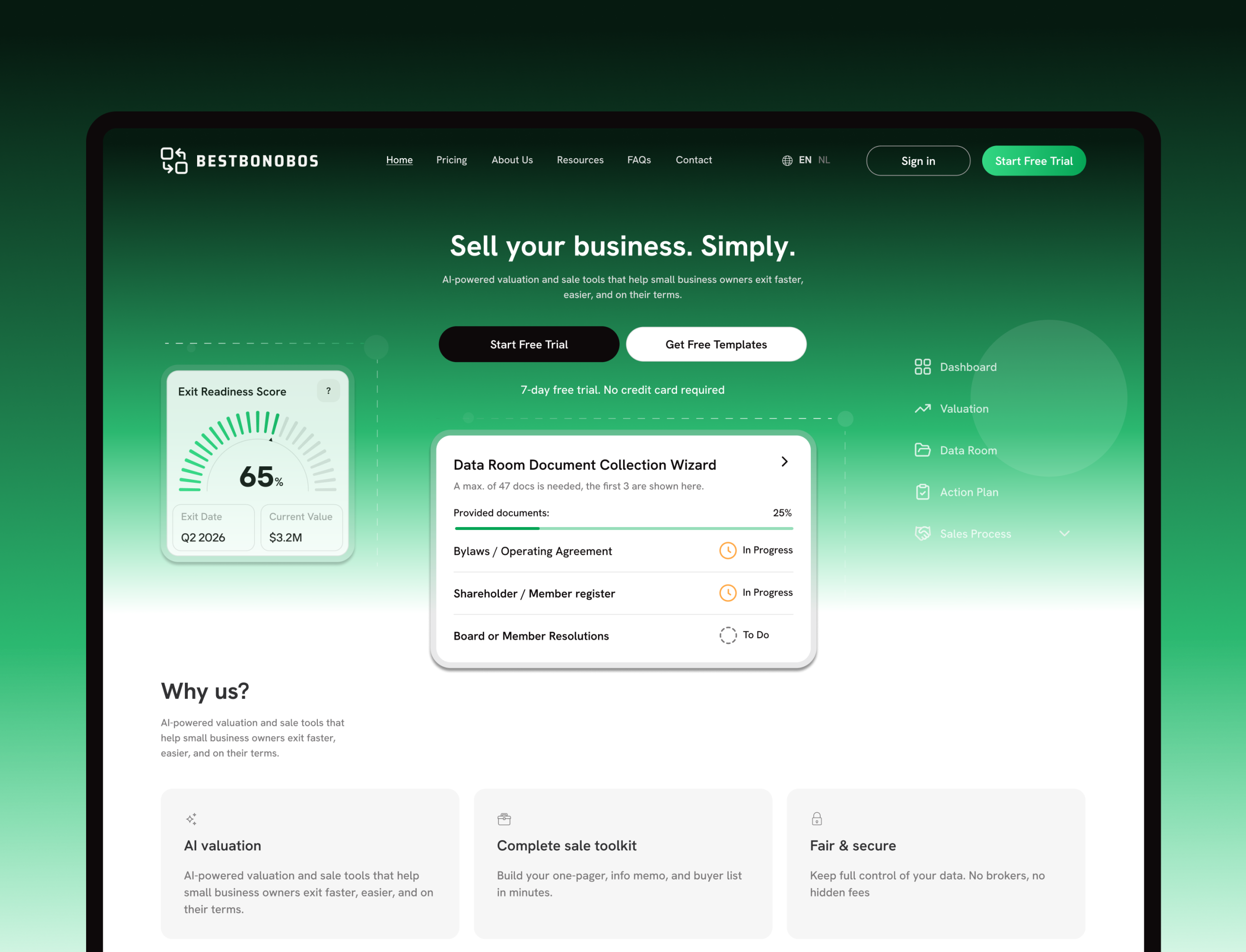
Co-Founder at BestBonobos
“Ralabs has delivered the MVP on time, and the early user feedback has been impressive. The team has kept in weekly contact to prioritize tasks and communicate via virtual meetings, emails, and messaging apps. Their cultural match and ability to give different options have been outstanding.”
Jonas Bertelsen ![]()
Chief Product Officer (CPO) at Cludo
“Working with the team was an experience in precision, expertise, and dedication. Their technical acumen ensured our GPT-Powered Q&A Chat was not only functional but ahead of the curve. We are proud to have collaborated with such a proficient team.”
Sam O’Brien
Co-Founder & Product Lead at Fillit

“Ralabs’ efforts resulted in the integration of DocuSign into the client’s contracting process, onboarding a new client in multiple markets, and clearing a backlog of tickets. The team’s project management, proactive approach, timeliness, and communication were hallmarks of their work.”
Gil Plotnizky
Co-Founder and Director at Equilibrio
“We had an amazing experience working with Ralabs.org on our website from day one, their team was professional, efficient, and truly understood our needs—covering everything from design to operations, reservations, and financial integrations with third-party software.”
Artem Arutyunyan
Head of Digital at Media Development Foundation
“With our High-load News Media project, we have reached our goals to increase analytics by rebuilding the infrastructure, boosting the performance of the website, and improving the news cloud panel for our journalists. Hromadske.ua is extremely thankful and satisfied with the costs spent since the results we gained are perfect.”
Agentic AI software development services
We build autonomous agents that execute multi-step workflows across your real tools, APIs, and data. The eight capability areas below cover the full stack — from orchestration and retrieval through to cost management and production monitoring.
AI orchestration systems and workflow automation
Your AI tools, databases, and business systems work in isolation — each needs manual input to feed the next. We build the AI orchestration layer that connects them into one automated pipeline.
- AI workflow automation across tools and APIs
- Low-code agentic orchestration with n8n and Make
- AI pipelines — multi-step execution with state management and event-driven triggers
Autonomous data extraction and ETL agents
Agents handle end-to-end autonomous task execution — extracting, cleaning, and routing data without manual triggers.
- Extract from documents, emails, PDFs, and enterprise systems
- Clean, normalize, and validate using AI reasoning
- Run ETL pipelines end-to-end with error handling and retry logic
- Feed structured data into analytics, CRM, and operations tools
Open-source agent framework integration
We design and integrate agent systems using open-source framework — no vendor lock-in, full ownership of your environment, whether on-premise or in the cloud.
- LangGraph — stateful, graph-based LLM orchestration
- CrewAI — role-based multi-agent systems
- AutoGen — conversational multi-agent coordination
- LlamaIndex — RAG pipeline orchestration and document ingestion
Vector database and semantic search infrastructure
Strong retrieval is foundational to agent performance. Without it, even the best model returns irrelevant results.
- Vector database setup: Pinecone, Weaviate, pgvector
- RAG (retrieval-augmented generation) pipelines
- Hybrid search — dense + sparse retrieval for precision
- Internal knowledge base integration and chunking strategy
LLM cost optimization and token management
Token costs grow fast as you scale. We apply a structured methodology
to keep enterprise AI efficient from day one.
- RAG for context efficiency — inject only what the agent needs
- Fine-tuning when needed — only for narrow, high-volume tasks where prompting underperforms
- Programmatic prompt engineering — prompts as versioned, tested infrastructure
Customer support automation
Support agents handle multi-turn interactions, retrieve from your knowledge base, apply business logic, and escalate to humans with full context.
- Multi-turn conversation with memory across sessions
- Retrieval from internal docs, CRM, and ticket history
- Defined escalation paths with full agent context on handoff
- Integration with Zendesk, Jira, ServiceNow
Agentic AI architecture on top of outsourced systems
We build agentic AI layers that sit on top of outsourced or legacy systems — reading, acting, and coordinating without requiring rewrites.
- API wrapper design for systems with limited native APIs
- RPA + agent hybrid for UI-level interactions where APIs don’t exist
- Event-driven triggers responding to outsourced system outputs
Multimodal agents
Real workflows rarely involve a single data type. Our multimodal agents process text, voice, images, and documents in one pipeline.
- Document processing: PDFs, scanned forms, contracts, invoices
- Voice transcription and intent extraction
LLM customization
Off-the-shelf models often miss domain logic, terminology, and required output formats. Adapt models on your data where prompting alone fails.
- Domain-specific instruction tuning
- Evaluation on real production scenarios
- Deployment on private cloud or on-prem
- Versioning, monitoring, and retraining workflows
Memory systems integration for AI agents
Without memory, agents lose context between steps and sessions. We design memory layers that persist relevant information and retrieve it when needed.
- Session memory for multi-step workflows
- Long-term storage of interactions and decisions
- RAG (Retrieval-Augmented Generation)
- Clear rules for persistence, expiry, and recall
Which agent type fits your workflow?
Filing documents, processing forms, running ETL pipelines. Defined inputs, defined outputs, no ambiguity required.
Underwriting, triage, fraud detection, compliance checks. The agent analyzes, applies rules, recommends, or executes. Core use case for cognitive automation in regulated industries.
Multi-turn queries that need context from internal knowledge bases, CRM, or connected systems. Beyond what a chatbot handles.
One agent retrieves, another processes, another acts. Built for workflows too complex for a single AI agent to handle reliably alone.
Ready to take your AI agent to production?
Let's explore your use case and define where agentic AI development services can bring the most value.
How we build agentic AI systems
Discovery and problem framing
Output: a scoping document covering goals, system dependencies, constraints, compliance requirements, and recommended agent architecture.
Agent architecture design
Output: a technical document covering agent topology, LLM orchestration logic, memory strategy, and data flow.
Build, test, evaluate
Output: each component tested in isolation. Evaluation criteria — correct output definition, failure modes, latency targets — set upfront.
Human-in-the-loop by design
If an agent hits a case outside its scope, it pauses, logs with full context, and routes to a human. Every action is auditable — satisfying EU AI Act and NIST AI RMF requirements.
Integration & deployment
Output: production deployment with monitoring (LangSmith, Weights & Biases), logging, RBAC access controls, and compliance documentation for regulated environments.
Evaluation and reliability monitoring — ongoing from launch
Output: golden test sets, automated regression testing on every prompt or model update, output quality scoring, anomaly detection, and monthly performance reports.
Optimization and scaling — ongoing
Real usage data drives token cost reduction, latency improvements, and model routing updates.
AI Agent development technologies we use
What agentic AI delivers for your business
Reduction in manual processing time
- Fewer manual handoffs in operational workflows — across document processing and routing projects delivered in fintech and healthcare between 2023 and 2025, we measured 40–70% reduction in manual touchpoints
- AI pipelines running without human triggers — ETL, data routing, form processing
- Back-office tasks completed in minutes, not hours
Faster time to decide
- Real-time data aggregation across disconnected systems
- Automated triage and prioritization in ops workflows
- Decision-ready outputs without analyst intervention
Lower operational cost at scale
- AI workflow automation replacing repetitive work across multiple roles
- Token cost optimization — our structured LLM methodology typically delivers 30–50% reduction in token costs within 60 days of go-live, driven by model routing and prompt engineering
Reduced dependency on legacy system rewrites
- AI integration via agents sits on top of your existing infrastructure — no migration required
- Agents connect to APIs, databases, and internal tools as-is
Industries we cover
Agents that extract and structure clinical data, automate prior authorization workflows, and surface relevant patient records for care teams. All deployments handle HIPAA compliance requirements at the architectural stage — not as an afterthought.
Agents that automate document review, run compliance checks across data sources, and execute multi-step onboarding or underwriting workflows without manual handoffs. Particularly effective for KYC, AML checks, and loan origination pipelines where data comes from multiple disconnected sources. Every deployment includes human-in-the-loop checkpoints for high-stakes decisions — agents flag, escalate, and log; humans approve. Our largest production deployments are in fintech.
Agents that monitor transactions, flag anomalies, generate audit-ready reports, and interface with core banking systems for data retrieval and reconciliation. Built with human-in-the-loop oversight for any action that touches financial records or triggers downstream processes.
Agents that track shipments across systems, manage exceptions, coordinate between carriers and warehouses, and update downstream operations automatically. Exception handling — the work that typically falls through the cracks between systems — is where agentic AI delivers the clearest ROI in logistics.
Agents that monitor infrastructure in real time, correlate signals across tools, classify threats, and trigger response actions within defined security policies. All actions are logged and auditable — a requirement for regulated security environments.
Agents that process and tag content at scale, automate distribution workflows, and generate structured metadata from unstructured media assets.
FAQ
Agentic AI development builds systems that take actions, not just generate outputs. A traditional AI model responds to a single prompt. An agentic AI system receives a goal, breaks it into steps, selects tools, handles errors, and completes the task autonomously. Agentic systems run workflows; standard AI answers questions.
RPA automates fixed, rule-based processes and breaks when rules change. Agentic AI reasons about goals, adapts to unexpected inputs, and handles unstructured data — documents, emails, API responses — that RPA cannot process. Where RPA follows a script, an AI agent makes decisions.
An architecture where multiple specialized AI agents work together on a shared goal — one retrieves data, another applies logic, another validates the result, another triggers an action. More reliable than a single agent for complex workflows because each agent operates within a defined scope.
It depends on complexity, integrations, and scale. A focused AI agent for a single, well-defined workflow — such as a document extraction pipeline or a support automation layer — typically starts from $15,000–$25,000 and takes 3–6 weeks. Production-grade multi-agent systems are significantly more complex. With multiple integrations, orchestration logic, monitoring, and access controls, these projects typically take 2–4 months and can range from $50,000+. We scope and estimate after a discovery session, so you get a number based on your actual requirements.
A focused AI agent for a contained workflow: 3–6 weeks. A system with multiple integrations, memory, and monitoring: 2–4 months. Timeline depends on integration complexity and the depth of testing, monitoring, and observability the deployment requires.
LangGraph, CrewAI, and AutoGen as primary agent frameworks. LangGraph for stateful workflows; CrewAI for role-based multi-agent systems; AutoGen for conversational setups. LlamaIndex for RAG. Framework choice is made at the architecture stage and explained in the architecture document — not chosen by default.
A chatbot responds to messages. An AI agent receives a goal, plans steps, uses tools and APIs, and executes tasks across systems — often without further input. Chatbots answer; agents act.
Every agent architecture we design includes defined action limits and escalation paths from day one. If an agent hits a case outside its scope, it pauses, logs with full context, and routes to a human via Slack, email, or ticketing. Nothing irreversible happens without a human-in-the-loop. All actions are auditable — in compliance with the EU AI Act and similar compliance requirements.
No. AI integration via agents sits on top of your existing infrastructure — APIs, databases, internal tools as-is. Most deployments start with one contained workflow, prove value, then expand. Faster, lower risk, and cheaper than migration.
The clearest signal is a workflow with multiple steps, recurring manual handoffs, and measurable cost — in time, headcount, or error rate. If your team moves data between systems by hand or follows the same decision logic repeatedly, that’s a strong starting point. If you’re unsure where to begin, our agentic AI consulting services help teams identify the highest-value workflows and define a realistic scope before development starts.