DEVWorld Amsterdam: My Talk on Measuring AI Adoption
Published: May 14, 2026
5 min read
The latest update: May 19, 2026
Roman Rodomansky
Co-Founder & COO at Ralabs, n8n Official Ambassador, Claude Community Ambassador
Introduction
On May 8, I spoke at DEVWorld Conference in Amsterdam — a two-day event for engineers, tech leads, and engineering managers that brings together 5,000+ people from 86 countries. The conference covered real-world lessons on building scalable systems, integrating AI into engineering workflows, securing modern applications, and leading high-performing tech teams. One of the largest developer events in Europe.
The speaker lineup included representatives from Tesla, AWS, GitHub, Oracle, Tailscale, Netlify, GitBook, Stripe, Aerospike, Cerbos, and others.
About 90% of talks were genuinely technical — React Native, DevOps, production systems, and so on. The AI sessions were grounded in production-ready agents and the DevOps side of agentic systems. A few management topics too — measuring AI adoption, motivating teams to use AI. That’s where my talk fits in.
My session: «Measuring AI Adoption Across People & Orgs»
The same team, different maturity levels, conflicting signals — this is what happens when you measure AI adoption by token count alone
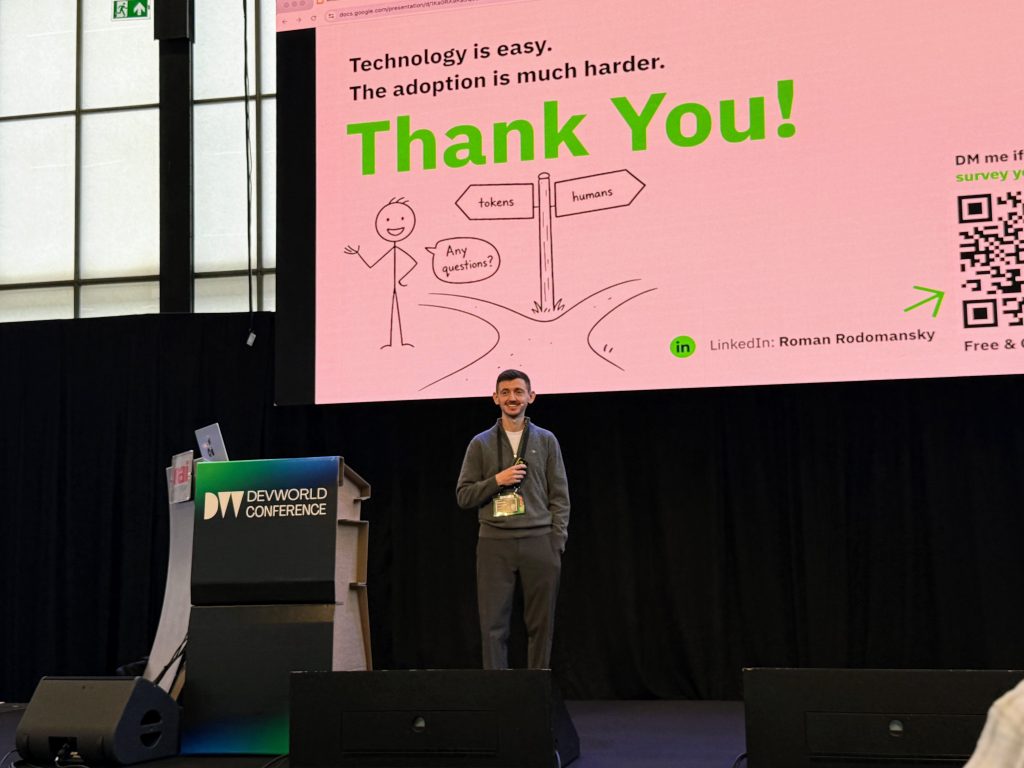
600–800 people in the room. The hall was full, which felt great.
I’ve been building something at Ralabs that I care about a lot: a way to actually measure AI adoption — not just among engineers, but across the entire organization. That’s what I spoke about. Not token usage. Adoption.
The conference runs in a silent disco format: attendees wear headphones and listen to audio feeds from whichever stage they choose. It feels like recording a podcast for a full room — no noise from adjacent stages. Because everyone could hear clearly, people followed actively and participated without hesitation.
I asked the audience two questions:
First: if you had to name a colleague who uses AI the most, could you do it? About half the room raised their hands. I expected more. It tells you something about how visible AI usage really is inside teams.
Second: do you agree that token count alone is a reliable measure of AI productivity? About 80% said no. Which is precisely my position.
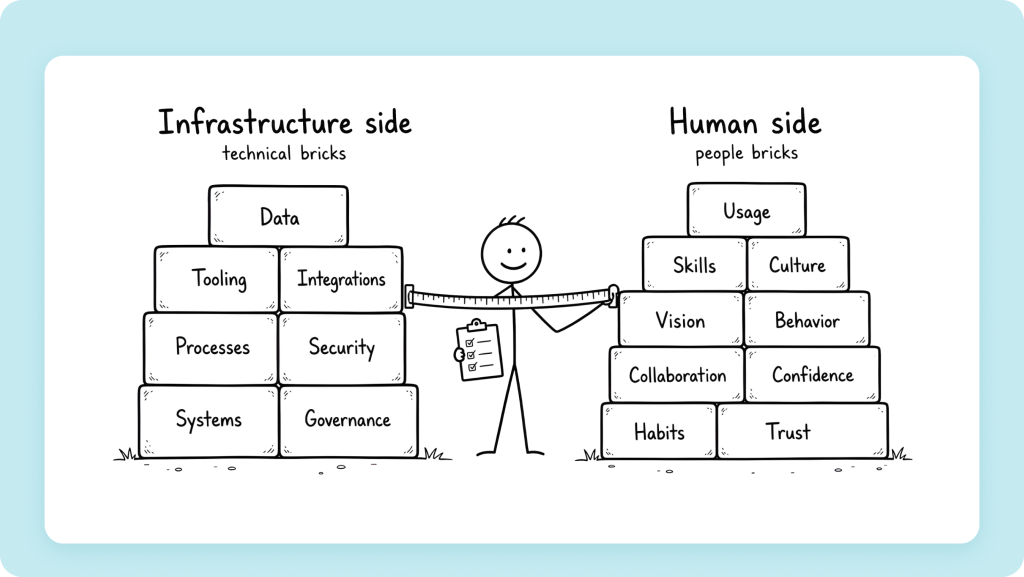
Most AI budgets go to tools, but skills, habits, and culture are where adoption actually happens
The token problem
The questions clients and teams are already asking are exactly what the methodology was built to answer
I also caught a talk on the main stage from a speaker at Tailscale — a big company, interesting presentation. Their approach to measuring AI adoption is built around token usage: more tokens spent means better productivity. Tokenmaxxing.
I think that’s not quite right. You can’t control what people put into context. Someone uploads a PDF — token count goes up immediately. That tells you nothing about how they’re actually using AI. It’s a quantitative metric, but it doesn’t show quality. On its own, it’s too simplified. Many companies use this approach right now because no one has built anything better yet. That’s exactly why I wanted to share what we built at Ralabs.
Three phases, one main message
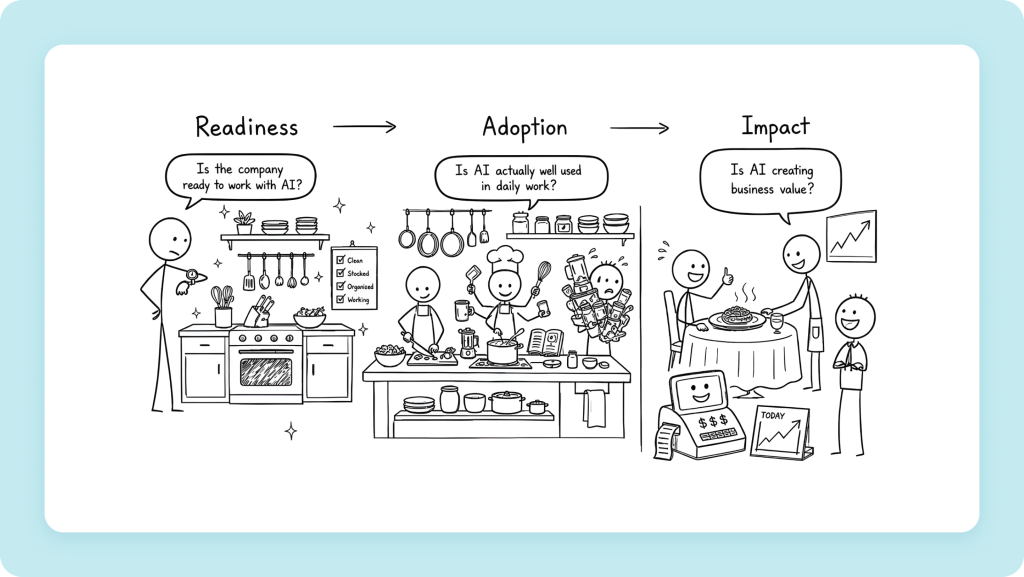
Every company moves through three phases — most are stuck in Adoption while trying to measure Impact
Every company moves through three phases: Readiness, Adoption, and Impact.
The core of my presentation was Adoption — how deeply AI is actually used in daily work. Because that’s where most companies are right now, and they trying to understand how to use AI well. But at the same time, everyone wants to measure Impact immediately. I think that’s the wrong order. You need to build the foundation first. And the foundation is people, not tools.
The numbers back this up. According to Deloitte (2026), companies spend 93% of AI budget on technology and only 7% on people. BCG says 70% of AI value comes from people — not algorithms or technology. And McKinsey found that only 1% of organizations describe themselves as AI mature.
When I talk about investment, I mean two types. Infrastructure investment — tools, subscriptions, tokens, integrations. And human investment — skills, habits, culture, confidence. Most companies focus almost entirely on the first. But that’s exactly where the mismatch is: the money goes to tools, and the value comes from people. You can buy all the right tools and still see almost no adoption if you haven’t invested in the humans using them.
My main message: 80% of your effort should go to people. 20% to tools.
Download the full presentation from Roman's DEVWorld talk — including the AI adoption measurement methodology, practices of effective AI adoption, and real observations from running this inside Ralabs
The AI Adoption Maturity Index
The methodology behind the talk is something we built internally at Ralabs after finding that existing tools didn’t meet our needs. They measure what has already happened. We wanted to understand why it happened and what’s possible.
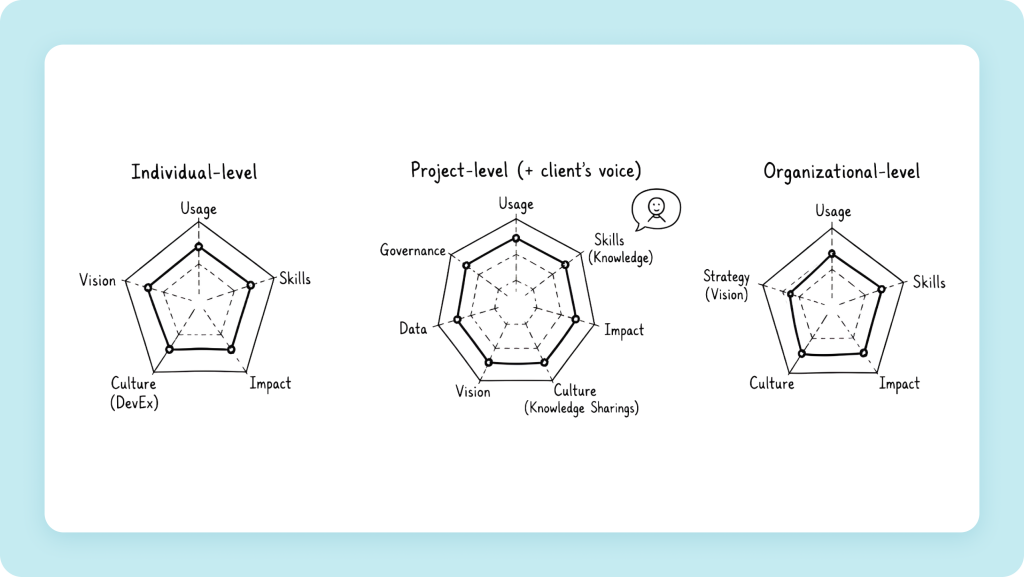
The AI Maturity Index measures different dimensions at each level: Usage, Skills, Impact, Culture, Vision, Governance, Data & Strategy
So we built our own survey-based AI Adoption Maturity Index. It covers three audiences, each with their own survey: technical people (engineering, design, QA) and non-technical people (PM, sales, finance) are measured across four dimensions: Usage, Skills, Impact, and Culture. The client survey covers a different set: Visibility, Value, Trust, and Future intent.
The AI adoption journey: curiosity, experimentation, consistency, leadership, and finally — culture
Each person gets a maturity score mapped to one of five levels — from L1 Observer to L5 Native.
What the index produces:
Per-person: maturity score mapped to a level, broken down by dimension
Per-project: aggregated team scores and project-level adoption assessment
Per-org: distribution across levels, dimension heatmaps, trend over time
For clients: satisfaction and perception scores across Visibility, Value, Trust, and Future intent
Components of AI Maturity Model
The scoring system includes anti-gaming questions and consistency checks to make sure results reflect what people actually do, not what they think they’re supposed to say. 15-minute surveys run quarterly — a full assessment every three months, with shorter check-ins each sprint and a team retro format in between. The output gives you a picture at three levels: individual, team, and organization.
Short check-ins every sprint, team retros in between, full survey every three months
What makes it different from productivity frameworks like DX or APEX is the focus. Those tools measure outcomes. This measures the human side — skills, habits, culture, blockers, and whether people are actually sharing AI knowledge across their teams. No GitHub integration will ever tell you that someone feels behind and is worried about it.
Three levels of measurement: person, team, and organization
The methodology got a lot of attention
After the talk, many people came up with questions — how do you work with people who are resistant to AI adoption? What culture makes people actually want to fill in a survey? Do you see orrelations between top performers and high maturity scores? And a lot simply asked: how do I get access to this tool?
One question stood out: are we correlating survey results with GitHub metrics? We’re not doing that yet, but it’s the right next question, and we want to work on it.
The interest carried over to LinkedIn — dozens of people reached out specifically asking about the methodology and how to get access to the tool.
How mature is your team's AI adoption?
AI Maturity Index — a free assessment form that shows
where your team stands and where to focus next.
Roman Rodomansky
Co-Founder & COO at Ralabs
To sum up, DEVWorld was a great conferences — well organized, genuinely technical, and full of people working on real problems. Amsterdam has a strong IT ecosystem, and the energy at an event like this reflects that. It was also a great opportunity to share something we’ve been building seriously — and see it land with the right audience. I’d happily come back with new data, new ideas, and new tools to share.
Technology is easy. The adoption is much harder.
Roman Rodomansky is Co-Founder & COO at Ralabs. His insights on leadership have been featured in Harvard Business Review.