
Introduction
As fintech platforms grow, so do the demands on their data infrastructure. From customer onboarding and fraud detection to reporting and product analytics, these companies handle large volumes of structured and semi-structured data every day.
Choosing the right approach for ingesting and transforming that data – whether extract-transform-load (ETL), extract-load-transform (ELT), or a mix of both – directly impacts how quickly teams can act, how well they stay compliant, and how easily they scale.

ETL and ELT: what’s the difference?
ETL applies transformation rules before loading data into the warehouse. According to AWS, this ensures only clean, structured data enters the system, helping maintain accuracy and reduce downstream errors.
ELT loads raw data into the warehouse first, then applies transformations using built-in compute resources. This approach supports real-time analysis and allows analysts to work with unstructured data on the fly.
Both models are widely used in fintech. The right choice depends on how much control you need upfront, how quickly you need insights, and how flexible your platform must be.
Key differences at a glance
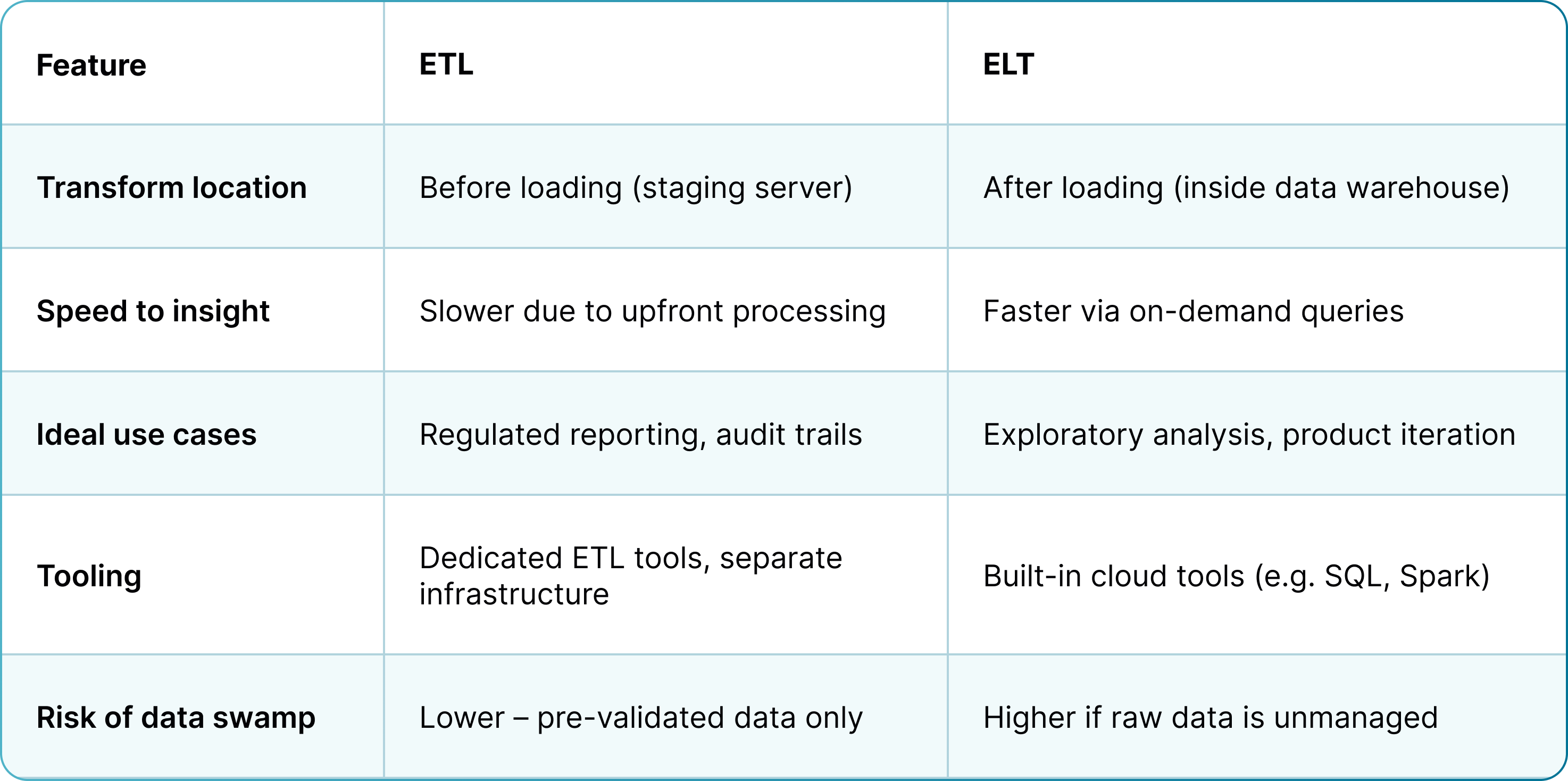
Making the trade-off: what fintech teams should consider
In ETL-based pipelines, fintech teams typically extract records from transaction systems, payment gateways, and KYC platforms, then cleanse, validate, and enrich the data before loading it into a central warehouse. This ensures every downstream report relies on a consistent and compliant dataset, especially important for lending decisions, anti-fraud monitoring, and regulatory filings.
In ELT workflows, raw data – including event streams and user activity logs – is loaded directly into cloud-native warehouses. Product managers, analysts, and data scientists can query the data immediately and apply transformations within the warehouse. This speeds up experimentation, reduces bottlenecks, and allows teams to iterate on insights without rebuilding pipelines.
Trade-offs in practice
Performance and scalability
ETL pipelines require schema updates and infrastructure changes when source formats shift. ELT offers flexibility and parallel compute power but needs solid governance to stay clean and useful.
Cost and complexity
ETL systems often rely on licensed tools and staging servers, adding overhead. ELT pipelines use the cloud’s native compute, lowering costs, but poor controls can turn your warehouse into a data swamp.
Governance and control
ETL enforces validation before data enters the system. ELT supports broader data types (like JSON logs or API payloads), but without strict rules, messy data can slip into production.
Reliability and risk
ETL tools typically have built-in validation and rollback features. ELT scripts, unless versioned and tested, may lead to inconsistent results across teams or break dashboards silently.
We help fintech teams build scalable, automated data pipelines that reduce onboarding time, improve data quality, and support real-time insights.

CEO and Co-Founder at Ralabs
Examples from the field
Hybrid compliance at a European neobank
A neobank adopted a hybrid model: ETL pipelines handle compliance reporting using controlled schemas and validation steps. ELT pipelines power dashboards and anomaly detection models, allowing product teams to move fast without disrupting regulatory workflows.
High-frequency trading platform
A trading analytics company shifted from ETL to ELT to support large-scale event ingestion. By loading and transforming data in place, they reduced the time to detect trading anomalies from hours to minutes.
When manual ETL breaks: the case for automation
Manual ETL processes don’t scale well. Fintech platforms that rely on customer-uploaded files, like transaction exports or onboarding data, often face:
- Inconsistent or incorrect column headers
- Mismatched data types (e.g. text instead of dates)
- Missing required fields or extra, unused columns
- Human errors in large files (100,000+ rows)
- Delays caused by engineering teams writing custom scripts for every client
For multi-tenant SaaS platforms or white-label fintech tools, these problems multiply as each new client brings unique formats, naming conventions, and quality issues.
Solving it with ETL-as-a-Service
To address these issues, some fintech platforms are deploying ETL-as-a-Service – a purpose-built solution that automates file validation, transformation, and onboarding. Instead of engineers manually inspecting every file, clients can upload data through a self-service interface and receive immediate feedback.
Core features include:
Semantic header matching
Maps columns even if the names differ (e.g., “DOB” → “BirthDate”).
Schema validation per client
Each tenant has a tailored schema. The system enforces this during upload.
Data type checking and conversion
Validates integers, dates, and strings; converts values like “NULL” into proper nulls.
Missing or extra field detection
Flags when required columns are missing or when unneeded columns appear.
Upload reports and audit trails
Clients get a full validation report with counts, errors, and conversion notes. All uploads are timestamped and stored.
Large file handling
Built to process 100k+ row files using chunking and parallel workflows.
Role-based access and API integration
Supports admin and user roles. Also allows file uploads via webhook or API.
These capabilities not only reduce onboarding time but also increase reliability. No more guessing what went wrong in a file. Clients get actionable feedback immediately and can fix issues without engineering delays.
Why automation matters in fintech
ETL-as-a-Service doesn’t replace ETL or ELT, it enhances them. It brings ETL-level control to client uploads while preserving the agility of ELT. For platforms that onboard new clients often, this kind of automation:
- Frees up data teams from low-value manual work
- Reduces onboarding time from days to hours
- Improves data quality before anything enters production
- Supports compliance by enforcing per-tenant validation rules
- Makes self-service onboarding possible, even for non-technical users
Final thoughts
The choice between ETL and ELT isn’t about picking one side. Fintech companies need both structure and speed, and increasingly, automation to bridge the gap.
ETL ensures clean, compliant data for reporting and governance. ELT delivers flexibility for fast-moving teams working with diverse data. Automation, especially in onboarding and validation workflows, helps make both approaches more sustainable as fintechs scale.
A hybrid model, powered by tools like ETL-as-a-Service, allows fintech platforms to grow faster, onboard clients more smoothly, and stay compliant – without trading off control or agility.