Introduction
Answer these five questions about your own product. Don’t look anything up.
01
Can you describe your data model from memory — the entities, who owns what, where the state actually lives?
02
Can you explain what your auth middleware does, in your own words?
03
Do you know what happens when two users do the same thing at the same time?
04
Have you read every line of code in the product, including the parts you didn’t write?
05
Could you hand the codebase to a stranger tomorrow and have them ship a feature within a week?
Four or five honest “yes” answers and you’re further along than most. Two or fewer, and everything you’ve built is sitting on a foundation nobody on the team fully understands. That gap is the subject of this piece.
According to YC partners Jared Friedman and Garry Tan, around 25% of startups in the Winter 2025 batch reported that roughly 95% of their code was AI-generated. The point Friedman made alongside it tends to get dropped: these were highly technical founders who could have written the code themselves. The number isn’t a story about non-technical people shipping software. It’s a story about how fast the first draft has gotten, for everyone.
Recently, Ralabs hosted a Tech Talk on what happens after the prototype works — the part nobody puts in the demo video.
Stephan Moerman, CTO at Kommit, has scaled an MVP past 150,000 users without a rewrite and built engineering teams in under 60 days across healthcare, fintech, and SaaS. Stasia Yasynyshyn, Head of Business Development at Ralabs, has partnered with 80+ companies on delivery and talks to founders coming out of the vibe-coding phase nearly every week — it’s now one of the most common starting points clients arrive with. What follows is the gap they both see, and the two frameworks that help you spot it before it costs you.
Together, they walked through the gap most founders fall into, and the two frameworks that help you see it coming before it costs you. Here’s what came out of the conversation. Watch the full Ralabs Tech Talk on YouTube.
The prototype was never the hard part
Vibe coding made the first draft cheap. What used to need a team, a budget, and a sprint calendar can now be built over a weekend. That isn’t a problem to wave away — it’s a real shift, and a good one for founders who need to know whether an idea works before spending six figures finding out.
What gets skipped is the part the tools are bad at: a clean data model, defined module boundaries, stable deployment, logging, monitoring, and a clear sense of which code is temporary and which is meant to hold weight. You don’t need to build a skyscraper on day one. You also shouldn’t build your business on wet cardboard.
Not every vibe-coded codebase is the same, though, and the difference matters more than the tooling. When an engineer vibe codes, AI is a productivity tool layered on top of existing judgment. When a non-technical founder does it, the output usually needs a much deeper architectural review before anyone can safely build on it — there’s often no pattern to follow, and occasionally a hardcoded password sitting in plain sight. The skill being tested has quietly changed: the question used to be can you code? Now it’s do you understand the business logic of what you’ve built?
The hostage problem
Here’s the pattern Stasia sees on a near-monthly basis. A founder builds a prototype to test demand — the right use of vibe coding. Users show up. Revenue starts. And then the founder becomes a hostage to their own platform.
Paying users mean you can’t stop to fix the foundation. Every week brings pressure to ship the next feature instead. The codebase that was supposed to be temporary scaffolding becomes the system the whole business runs on, and the fix gets deferred until it can’t be — usually right after something breaks in front of a customer. By then you’re changing tires at full speed, because there’s no pit stop once paying users are active.
The cost of waiting isn’t only technical. By the time a team is brought in under crisis conditions, the company has often already lost clients, taken a reputational hit, and burned through the runway it was trying to protect.
It looks like this in practice. Imagine a fintech product crosses 40,000 users on an MVP built with no multi-tenant data separation. Everything runs fine — until an enterprise prospect sends a security questionnaire. The questionnaire asks how customer data is isolated between tenants, and there’s no answer that survives review. The deal that would have funded the next year doesn’t close, and the fix that should have been a day-one decision is now a re-architecture against live production data. The prototype ran fast today and quietly blocked the company from ever onboarding a serious client. That’s the shape of the hostage problem: the thing that let you move fast becomes the thing you can’t move without breaking.
Technical debt isn't the problem. Interest is
Most teams talk about technical debt — the cost of shortcuts, paid back later on a schedule you mostly control. Stephan’s reframe is worth carrying into every roadmap conversation: when a team loses understanding of its own codebase, the problem stops being debt. It becomes interest.
Interest compounds. Every new feature takes longer than the last. Every bug fix risks introducing two more. Nobody wants to refactor because nobody is confident what will break. The codebase stops being something the team works with and becomes something they work around.
The signal that interest has started accruing: someone on the team can’t explain why a piece of code is there or how it works. Once that’s true of more than a couple of components, the rewrite clock has started, whether or not anyone’s watching it.
BLAST: five questions before you write
a line
Stephan’s answer to “how do you stay disciplined inside something this fast” is a five-question framework — five things to settle before a vibe-coded build either ships safely or becomes the failure the acronym names.
- Business outcome. What specific thing are you trying to prove? Careless MVPs fail by trying to solve every feature at once instead of isolating one falsifiable question: will anyone pay for this, or does this integration actually work.
- Legal and data risk. What kind of data is the product touching? Fake demo data is low-stakes. The moment a prototype handles real customer records, invoices, or health and transaction data, the standard for access control, retention, and encryption has to change immediately — not eventually.
- Architecture boundary. Is this throwaway code meant to teach you something fast, or is it the long-term foundation? Decide upfront, because the answer changes how much structure you owe it from day one. A codebase with zero architectural pattern — or a hardcoded credential — is what turns a routine handoff into expensive, senior-level reverse engineering.
- Security. What must never happen? Name the specific thing that would be embarrassing, expensive, or illegal for your business, and guard against it before you build, not after the incident.
- Technical handoff. When does ownership move from AI-generated output to a human who’s accountable for it? Recognizing that moment is the one skill vibe coding doesn’t teach you — the tool never tells you when it’s out of its depth.
Four stages, and the one moment
that matters
Stephan’s second framework maps the lifecycle every vibe-coded product moves through, named or not:
- Spec — cheap to define.
- Scaffold — fast to build, where technical debt quietly begins.
- Substance — things work, but everything is getting harder.
- Scale — production reality, no more room for shortcuts.
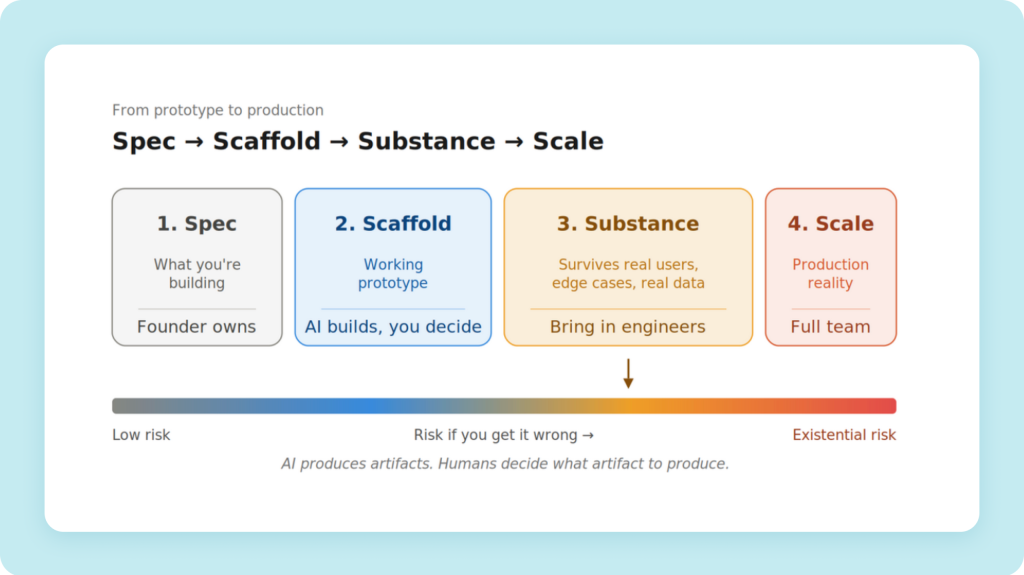
The bring-in moment — where serious engineering stops being optional — is Stage 3, Substance. That’s when the founder spends more time on bugs than on customers, and a question from a new developer takes a week to get a real answer.
Stephan and Stasia landed on the same line. Hiring at Stage 3 means a team builds on momentum. Hiring at Stage 4 means a team does CPR — keeping a failing system alive instead of building on a solid one. The work looks similar from outside (code review, refactoring, security passes), but the experience inside the company is completely different. The gap between a momentum hire and a rescue mission is usually about three months, and it’s recoverable right up until it isn’t.

Two perspectives, one pattern
Key takeways from Stasia, across client conversations:
- Inquiries from founders leaving the vibe-coding phase rise month over month. This isn’t a niche problem.
- Vibe coding itself isn’t the issue. As a zero-to-one tool to test an idea cheaply, it’s exactly right.
- Brutally honest feedback from outside the founder’s network surfaces problems internal teams have stopped noticing.
- No architectural pattern, or a stray hardcoded credential, is the clearest sign that reverse engineering — not a quick patch — is what’s actually needed.
Key takeaways from Stephan on what breaks once a team stops understanding its own code:
- AI is excellent at a fast first draft and consistently weak at the boring fundamentals: data modeling, module boundaries, deployment, logging, monitoring.
- AI can’t reliably tell throwaway code from load-bearing code. That judgment still needs human engineering experience.
- The real cost of delay isn’t a bigger invoice later. It’s turning senior engineers into a cleanup crew for two to four months instead of letting them build the roadmap.
Stephan closed on an idea he credited to Andrej Karpathy: you can outsource your thinking to AI right now, but you can’t outsource your understanding, or your responsibility for what the product does. Founders get to use AI to move faster. They don’t get to hand off the accountability that comes with it.
From vibe-coded to production-ready
This is the exact gap Ralabs works in. We take vibe-coded MVPs — built fast, tested on real users, now carrying more weight than they were designed for — and turn them into systems that hold up under scale, security review, and investor due diligence. We’ve audited and refactored 57+ MVPs across healthcare, fintech, and SaaS, and the path is consistent: audit first, harden security before touching architecture, refactor incrementally without breaking what works, and hand over documentation a new engineer can use on day one. No full rewrites by default — only what’s actually blocking production gets replaced.
A typical audit runs a few days and ends with two things: a prioritized findings document mapping how your codebase actually behaves under load, security, and data separation, and an honest read on whether you’re at Stage 2 or Stage 4. You decide what to do with it.
If your prototype is live, users are real, and you’re starting to feel the ceiling — send us your repo. No commitment, and a response within one business day.
Send us your repo overview. We will come back within one business day with an honest read on where you stand.

Head of technology at Ralabs